Economic bubbles—periods where the price of an asset exceeds its intrinsic value by a significant margin—are recurring phenomena in the history of modern capitalism. From the Dutch Tulip Mania of the 1630s to the 2008 Global Financial Crisis and the more recent volatility in digital assets, bubbles follow a predictable pattern of displacement, boom, euphoria, profit-taking, and panic. While the “burst” often leads to necessary market corrections, the collateral damage to employment, savings, and global stability can be catastrophic.
Consequently, the role of policy in controlling these bubbles has become a central pillar of modern macroeconomics. Policymakers, primarily through central banks and regulatory bodies, employ a mix of monetary, fiscal, and macroprudential tools to prevent irrational exuberance from destabilizing the broader economy.
1. Understanding the Anatomy of a Bubble
To control a bubble, policy must first address its roots. Most bubbles are fueled by excess liquidity and speculative credit. When interest rates are low and money is “cheap,” investors seek higher returns in riskier assets. This influx of capital drives prices up, creating a feedback loop where rising prices attract more speculators, further decoupling the asset from its fundamental value.
The primary challenge for policymakers is the “Identification Problem.” Distinguishing between a structural shift (e.g., a genuine technological breakthrough) and a speculative bubble in real-time is notoriously difficult. Intervening too early can stifle innovation and growth; intervening too late can lead to a systemic collapse.
2. Monetary Policy: The “Blunt Tool”
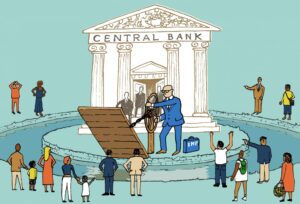
Central banks, such as the Federal Reserve or the European Central Bank, have traditionally used monetary policy as the first line of defense.
- Interest Rate Adjustments: By raising the federal funds rate, central banks increase the cost of borrowing. This reduces the leverage available to speculators and cools down demand in overheated sectors like real estate or equities.
- Quantitative Tightening (QT): By reducing the size of their balance sheets (selling government bonds), central banks withdraw liquidity from the financial system, making it harder for speculative manias to find the “fuel” they need to grow.
The Limitation: Monetary policy is a “blunt tool.” Raising interest rates to pop a bubble in the tech sector may inadvertently cause a recession in the manufacturing sector. This lack of precision often leads central banks to adopt a policy of “benign neglect”—waiting for the bubble to burst and then cleaning up the mess through liquidity injections.
3. Macroprudential Policy: The “Scalpel”
In response to the limitations of monetary policy, the post-2008 era has seen the rise of macroprudential regulation. Unlike monetary policy, which affects the entire economy, macroprudential tools can be targeted at specific sectors where risks are accumulating.
- Loan-to-Value (LTV) Ratios: To control a housing bubble, regulators can mandate that homebuyers provide a larger down payment. This limits the amount of debt used to purchase property, reducing the risk of mass defaults if prices drop.
- Capital Buffers: Regulators can require banks to hold more capital against certain types of risky assets. This ensures that even if a specific bubble bursts, the banking system remains resilient enough to continue lending to the rest of the economy.
- Sector-Specific Credit Limits: Policy can limit the total exposure a financial institution can have to a single sector, such as commercial real estate or cryptocurrency markets.
4. Fiscal Policy and Tax Disincentives
While central banks handle money supply, governments use fiscal policy to influence market behavior. Taxation is a powerful tool for curbing speculative excess.
- Capital Gains Tax: Higher taxes on short-term capital gains can discourage “flipping” assets and incentivize long-term investment over speculation.
- Eliminating Subsidies: Bubbles are often unintentionally supported by government policy. For example, mortgage interest tax deductions can encourage over-investment in residential real estate. Removing these incentives during a boom can help normalize prices.
5. The Challenge of “Irrational Exuberance” and Information
One of the most difficult aspects of policy is managing the psychological element of bubbles. Former Fed Chairman Alan Greenspan famously coined the term “irrational exuberance” to describe the behavior of investors during the dot-com boom.
Transparency and communication policies (often called “Forward Guidance”) are essential. If a central bank clearly communicates that it views certain asset prices as unsustainable and intends to raise rates, it can sometimes “lean against the wind” and cool the market without a hard landing. However, if the market believes the “Central Bank Put” (the idea that the government will always bail out investors), moral hazard will continue to drive speculative bubbles.
6. Sustainability and the New Era of Bubbles
In the 2020s, policy must also contend with the “Green Bubble.” As billions of dollars flow into ESG (Environmental, Social, and Governance) funds and clean energy startups, there is a growing risk of a speculative bubble in the sustainability sector.
Here, the role of policy is two-fold:
- Standardization: Establishing clear definitions of what constitutes a “sustainable” investment to prevent “greenwashing” and misallocation of capital.
- Strategic Support: Ensuring that while speculative capital might fluctuate, the underlying transition to a low-carbon economy remains supported by stable, long-term fiscal frameworks.
7. Conclusion: The “Lean vs. Clean” Debate
The debate over the role of policy in controlling bubbles generally falls into two camps. The “Cleaners” argue that bubbles are impossible to identify accurately and that policy should only react to mitigate the damage after the burst. The “Leaners” argue that the cost of modern financial crises is too high to remain passive; they advocate for proactive intervention using a combination of interest rates and macroprudential “scalpels.”
Ultimately, the most effective policy framework is one of Resilience. Policy cannot—and perhaps should not—eliminate all market cycles. However, by enforcing strict capital requirements, discouraging excessive leverage through taxation, and maintaining transparent communication, policymakers can ensure that when the next bubble inevitably forms, its burst does not take the entire global economy down with it.
Key Takeaways for Investors and Analysts
- Liquidity is the Driver: Watch central bank balance sheets as a leading indicator of speculative potential.
- Regulation is Localized: Macroprudential shifts (like LTV changes) often signal the end of a sector-specific boom before interest rates do.
- The Psychological Floor: Market stability depends on the credibility of the regulator; if the “moral hazard” remains, the bubble will likely grow larger.