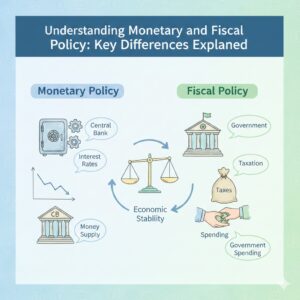
The global financial system is a complex web of transactions, but at its heart lies a single, powerful lever: the interest rate. Often described as the “price of money,” interest rates influence everything from the cost of a morning latte to the feasibility of a billion-dollar infrastructure project. For central banks, interest rates are the primary tool used to steer the economy, balancing the delicate scales between growth and stability.
This article explores the mechanics of interest rates, their integration into monetary policy, and the ripple effects they create across the global landscape.
1. What are Interest Rates?
At its simplest, an interest rate is the amount charged by a lender to a borrower for the use of assets. While we often think of this in terms of personal loans or mortgages, in the context of monetary policy, the most important rate is the base rate (or federal funds rate in the U.S.).
The Cost of Borrowing vs. The Reward for Saving
- For Borrowers: The interest rate represents the “rental cost” of capital. High rates make borrowing expensive, discouraging spending.
- For Savers: The rate represents the return on investment. High rates encourage individuals and firms to keep money in the bank rather than spending it.
2. The Role of the Central Bank
Central banks—such as the Federal Reserve (Fed) in the U.S., the European Central Bank (ECB), and the Bank of England—act as the “lenders of last resort.” Their primary mandate is usually twofold: price stability (controlling inflation) and maximum sustainable employment.
How the Central Bank Influences Rates
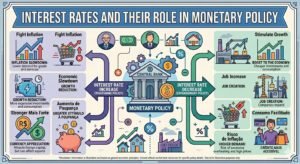
Central banks do not set the interest rate on your credit card directly. Instead, they set a “target rate” for overnight lending between commercial banks. When the central bank raises this target, it becomes more expensive for banks to borrow money. To maintain their profit margins, commercial banks pass these costs on to consumers and businesses, raising rates across the board.
3. Expansionary vs. Contractionary Monetary Policy
Monetary policy is generally categorized into two phases, depending on the economic climate.
Contractionary Policy (The “Brakes”)
When an economy is “overheating”—characterized by high inflation and unsustainable growth—the central bank will raise interest rates.
- Goal: To cool down the economy and bring inflation back to a target (usually around 2%).
- Mechanism: Higher rates reduce disposable income (due to higher debt payments) and make business expansion less attractive.
Expansionary Policy (The “Gas Pedal”)
During a recession or a period of stagnation, the central bank lowers interest rates.
- Goal: To stimulate economic activity and prevent deflation.
- Mechanism: Cheap borrowing encourages consumers to buy homes and cars, and businesses to invest in new projects and hiring.
4. The Relationship Between Interest Rates and Inflation
Inflation is the persistent rise in the general price level of goods and services. There is a fundamental, inverse relationship between interest rates and inflation, often visualized through the Fisher Equation:
Where:
- $r$ is the real interest rate.
- $i$ is the nominal interest rate.
- $\pi$ is the inflation rate.
If inflation is high, the “real” value of money is eroding. Central banks raise nominal rates ($i$) to ensure that the real cost of borrowing ($r$) remains high enough to discourage the excessive spending that fuels further inflation.
5. The Impact on Financial Markets
Interest rates are the “gravity” of the financial markets. When rates change, every asset class feels the pull.
The Bond Market
Bonds have an inverse relationship with interest rates. When new bonds are issued with higher yields (due to rising rates), existing bonds with lower yields become less valuable.
The Stock Market
Generally, rising interest rates are a headwind for stocks.
- Discount Rates: Future earnings are worth less when discounted at a higher rate.
- Profit Margins: Higher interest expenses eat into corporate profits.
- Alternative Returns: If a “risk-free” government bond offers 5%, investors are less likely to risk their money in the volatile stock market for a similar return.
6. Global Implications and Exchange Rates
Interest rates also dictate the flow of international capital. If the U.S. Federal Reserve raises rates while the Bank of Japan keeps them near zero, global investors will flock to the U.S. to earn higher returns.
- Currency Appreciation: Increased demand for a currency (to invest in higher-yielding assets) causes that currency to strengthen.
- Trade Balance: A stronger currency makes exports more expensive and imports cheaper, which can impact a nation’s trade deficit.
7. The Challenges of Modern Monetary Policy
In the post-2008 era, central banks have faced unique challenges, such as the Zero Lower Bound (ZLB). When interest rates hit zero, central banks can no longer lower them to stimulate the economy. This led to “unconventional” policies like Quantitative Easing (QE)—where central banks buy long-term securities to pump liquidity directly into the financial system.
Note: While QE can prevent a total economic collapse, it also carries the risk of asset bubbles and long-term inflationary pressures.
8. Summary: Why It Matters to You
Understanding interest rates isn’t just for economists; it’s essential for personal financial planning.
- Mortgages: A 1% difference in interest rates can mean tens of thousands of dollars over the life of a 30-year loan.
- Employment: High-interest environments often lead to a cooling labor market as companies prioritize cost-cutting over hiring.
- Retirement: For those living on fixed incomes, higher interest rates provide better yields on savings and CDs (Certificates of Deposit).
Conclusion
Interest rates are the pulse of the modern economy. By adjusting these rates, central banks navigate the narrow path between a sluggish recession and runaway inflation. While the tools of monetary policy are technical, their impact is deeply human—affecting how we save, how we spend, and how we plan for the future.
As we move further into a volatile global economy, staying informed about the decisions of central banks is more critical than ever. Whether you are an investor, a homeowner, or a student of economics, the “price of money” will always be the most important number to watch.