In the complex world of economics, the levers that govern a nation’s financial health are often shrouded in jargon. However, two primary tools stand above the rest: Monetary Policy and Fiscal Policy. While they both aim to promote economic growth, manage inflation, and maintain stability, they are managed by different authorities and utilize distinct mechanisms to achieve their goals.
Understanding these differences is crucial for investors, business owners, and citizens alike, as these policies directly impact interest rates, taxes, and the overall cost of living.
1. Defining the Core Concepts
Before diving into the nuances, let’s establish a clear definition for both terms.
What is Monetary Policy?
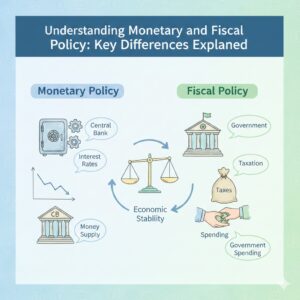
Monetary policy refers to the actions taken by a nation’s central bank (such as the Federal Reserve in the U.S. or the European Central Bank) to control the money supply and interest rates. The primary objective is usually “price stability” (controlling inflation) and ensuring the smooth flow of credit within the economy.
What is Fiscal Policy?
Fiscal policy involves the use of government spending and taxation to influence the economy. This is managed by the executive and legislative branches of government. By changing how much it spends on public services or how much it collects in taxes, the government can stimulate or cool down economic activity.
2. The Mechanics: How They Work
The “how” is where these two policies diverge most significantly.
The Tools of Monetary Policy
Central banks have a specific toolkit to manage the economy:
- Interest Rates: By raising or lowering the “federal funds rate” (or equivalent), central banks influence how much it costs for consumers and businesses to borrow money.
- Open Market Operations (OMO): This involves buying or selling government bonds. Buying bonds injects cash into the banking system; selling them pulls cash out.
- Reserve Requirements: The amount of cash banks must hold in reserve. Lowering this allows banks to lend more freely.
- Quantitative Easing (QE): In extreme cases, central banks create new money to buy long-term assets, lowering interest rates across the broader market.
The Tools of Fiscal Policy
Governments use two main levers:
- Government Spending: Investing in infrastructure, education, defense, or social programs. This puts money directly into the hands of contractors, employees, and citizens.
- Taxation: By lowering taxes, the government increases “disposable income,” encouraging people to spend. Conversely, raising taxes can slow down an “overheated” economy by reducing the money available for consumption.
3. Comparing the Two: A Quick Reference
| Feature | Monetary Policy | Fiscal Policy |
| Acting Authority | Central Bank (e.g., The Fed) | Government (Parliament/Congress) |
| Primary Tools | Interest Rates, Money Supply | Taxes, Government Spending |
| Implementation Speed | Fast (can change overnight) | Slow (requires legislative approval) |
| Target | Inflation & Interest Rates | Growth & Wealth Distribution |
| Political Influence | Generally Independent | Highly Political |
4. Expansionary vs. Contractionary Stances
Both policies can be “Expansionary” (used to fight a recession) or “Contractionary” (used to fight inflation).
Fighting a Recession (Expansionary)
When the economy slows down, the goal is to increase demand.
- Monetary: The Central Bank lowers interest rates, making it cheaper to get a mortgage or a business loan.
- Fiscal: The Government increases spending or cuts taxes to put more money in the pockets of consumers.
Cooling Inflation (Contractionary)
When the economy grows too fast, prices skyrocket.
- Monetary: The Central Bank raises interest rates, making borrowing expensive and encouraging saving.
- Fiscal: The Government reduces spending or increases taxes to take money out of circulation.
5. The Question of Time: Implementation Lags
One of the biggest differences between these two is the time lag.
Monetary policy is the “fast-acting” tool. The Federal Reserve’s Open Market Committee can meet and decide to change interest rates in a single afternoon. While the effects take months to filter through the entire economy, the decision itself is instantaneous.
Fiscal policy is the “slow-moving” tool. Changes in tax law or massive infrastructure bills must go through debates, committees, and votes. This process can take months or even years. However, once a fiscal project (like building a highway) begins, the impact on employment and local demand is often more direct and localized than an interest rate change.
6. Independence and Politics
Central banks are designed to be independent of political cycles. This is vital because the “right” economic move (like raising interest rates to stop inflation) is often unpopular with voters who want cheap credit. An independent central bank can make the “tough” choice without fearing an election.
Fiscal policy, however, is inherently political. Tax cuts and increased spending are popular campaign promises. This often leads to “deficit spending,” where the government spends more than it collects in taxes, resulting in national debt.
7. How They Interact
In a perfect world, monetary and fiscal policy work in harmony. During the 2020 pandemic, for example, many governments used expansionary fiscal policy (stimulus checks) while central banks used expansionary monetary policy (dropping rates to near zero).
However, they can also conflict. If a government spends aggressively (fiscal expansion) while a central bank is trying to fight inflation by raising rates (monetary contraction), the two policies can neutralize each other, leading to economic friction.
8. Conclusion
While they utilize different tools and are managed by different bodies, Monetary and Fiscal policies are the two pillars that support a modern economy. Monetary policy manages the “price” and “quantity” of money, while Fiscal policy manages the “distribution” and “source” of economic demand.
For the average person, these aren’t just abstract theories. They determine whether you can afford a home loan, how much you pay in income tax, and whether the prices at the grocery store remain stable or climb out of reach.