In the theater of modern economics, the two lead actors are Monetary Policy and Fiscal Policy. While they often perform different scripts—one managed by independent central banks and the other by elected governments—their performances are deeply interconnected. When they move in harmony, they can stabilize an economy and promote growth. When they clash, the result is often volatility, inflation, or stagnation.
Understanding the interaction between these two levers is essential for grasping how modern nations navigate business cycles, manage debt, and respond to global crises.
1. Defining the Instruments of Power
Before exploring their interaction, we must distinguish between the two mechanisms.
Fiscal Policy: The Government’s Wallet
Fiscal policy involves the use of government spending and taxation to influence the economy. Managed by the executive and legislative branches, its primary goals are typically resource allocation, income redistribution, and long-term infrastructure development.
- Expansionary Fiscal Policy: Increasing spending or cutting taxes to stimulate demand.
- Contractionary Fiscal Policy: Reducing spending or raising taxes to cool an overheating economy or pay down debt.
Monetary Policy: The Central Bank’s Compass
Monetary policy is the process by which a central bank (like the Federal Reserve or the ECB) manages the money supply and interest rates. Its primary mandate is usually “price stability” (controlling inflation) and, in many cases, maximizing employment.
- Expansionary Monetary Policy: Lowering interest rates and buying assets to make borrowing cheaper.
- Contractionary Monetary Policy: Raising interest rates to curb inflation and discourage excessive spending.
2. Modes of Interaction: Cooperation vs. Conflict
The relationship between these two policies can be categorized into three primary states:
A. Complementary (The Ideal Scenario)
In a recession, the “double-barreled” approach is often used. The government increases spending (Fiscal Expansion) while the Central Bank lowers interest rates (Monetary Expansion). This combined effort lowers the cost of borrowing for the government’s new debt while putting more money into the hands of consumers and businesses simultaneously.
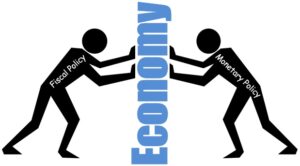
B. Conflicting (The Tug-of-War)
Conflict occurs when the two policies pull in opposite directions. A classic example is when a government engages in massive deficit spending (Expansionary Fiscal) during a period of high inflation. To prevent the economy from overheating, the Central Bank may be forced to raise interest rates aggressively (Contractionary Monetary). This “tug-of-war” can lead to high interest rates that “crowd out” private investment.
C. Passive vs. Active
Sometimes, one policy takes the lead while the other remains neutral. For decades, it was believed that monetary policy should be the primary tool for fine-tuning the economy, while fiscal policy focused on long-term structural goals. However, the 2008 financial crisis and the COVID-19 pandemic shifted this perspective, requiring both to be highly active.
3. Key Transmission Channels
The interaction between these policies flows through several economic channels:
- The Interest Rate Channel: Large-scale government borrowing can drive up the demand for loanable funds. If the Central Bank does not increase the money supply to accommodate this, interest rates rise, potentially neutralizing the stimulus effect.
- The Inflation Channel: If fiscal policy is too loose and the Central Bank is too “dovish” (keeping rates low), the excess liquidity can lead to rapid inflation, devaluing the currency and eroding purchasing power.
- The Debt Sustainability Channel: High interest rates set by monetary policy increase the cost of servicing the national debt. If debt-to-GDP ratios become too high, fiscal policy becomes “constrained,” as more tax revenue must go toward interest payments rather than public services.
4. The “Crowding Out” Effect
A pivotal concept in this interaction is Crowding Out. When a government borrows heavily to fund fiscal expansion, it competes with the private sector for capital.
If the Central Bank does not keep rates low, the increased demand for credit drives interest rates up. Higher rates make it more expensive for businesses to expand or for consumers to take out mortgages. In essence, the government’s increased activity “crowds out” private economic activity, potentially leading to a net-zero gain in GDP.
5. Modern Challenges: Quantitative Easing and Fiscal Dominance
In the 21st century, the lines between these policies have blurred.
- Quantitative Easing (QE): When Central Banks buy government bonds to lower long-term interest rates, they are effectively financing government deficits indirectly. While this provides liquidity, critics argue it reduces the “independence” of the Central Bank.
- Fiscal Dominance: This occurs when the level of public debt is so high that the Central Bank feels it cannot raise interest rates to fight inflation because doing so would cause the government to default or trigger a financial crisis. In this scenario, fiscal policy effectively “dominates” and dictates monetary policy.
6. Case Studies in Interaction
The 1980s Volcker Moment
In the early 1980s, the U.S. faced “Stagflation”—low growth and high inflation. While the Reagan administration pursued expansionary fiscal policies (tax cuts and defense spending), Fed Chair Paul Volcker enacted a brutally contractionary monetary policy, raising interest rates to nearly 20%. The conflict was painful in the short term but eventually broke the back of inflation.
The COVID-19 Response
The 2020 pandemic saw unprecedented coordination. Governments provided massive stimulus checks and business subsidies, while Central Banks slashed rates to zero and engaged in massive asset purchases. This “synchronized expansion” prevented a total economic collapse but contributed to the global inflationary surge seen in 2022 and 2023.
7. Conclusion: The Path Toward Coordination
The interaction between monetary and fiscal policy is a delicate balancing act. For an economy to thrive, policymakers must recognize that neither tool operates in a vacuum. Fiscal policy provides the structural foundation and social safety nets, while monetary policy provides the liquidity and price stability necessary for investment.
The ultimate goal is a Policy Mix that achieves sustainable growth without triggering runaway inflation or unmanageable debt. As we move further into a volatile global economy, the communication between Treasuries and Central Banks will be the determining factor in national prosperity.
Would you like me to create a summary table comparing the effects of different policy combinations on GDP and inflation?