The relationship between taxation and economic growth is one of the most debated topics in modern macroeconomics. It sits at the heart of political campaigns, fiscal policy shifts, and the structural development of nations. While proponents of low taxes argue that minimal intervention fosters innovation, supporters of robust taxation emphasize the necessity of public investment in infrastructure and human capital.
Understanding this dynamic requires looking beyond simple “high” or “low” tax brackets and examining how the structure, efficiency, and utilization of tax revenue influence a nation’s GDP.
1. The Classical View: Taxes as a Drag on Growth
From a purely neoclassical perspective, taxes are often seen as “distortions.” When the government levies a tax, it changes the incentives for individuals and firms.
- Investment Incentives: High corporate taxes can reduce the after-tax return on investment (ROI). If companies have less capital to reinvest, they may scale back on research and development (R&D) or physical expansion.
- Labor Supply: High personal income taxes can create a “leisure bias.” If an individual loses a significant portion of their next dollar earned to the state, they might choose to work fewer hours or retire earlier.
- Capital Flight: In a globalized economy, capital is highly mobile. High tax jurisdictions risk losing wealthy individuals and multinational corporations to “tax havens” or more competitive neighbors.
The Laffer Curve is the most famous representation of this concept. It suggests that there is an optimal tax rate that maximizes revenue without stifling economic activity. If taxes are too high (moving toward 100%), people stop working or find ways to evade taxes, leading to a decrease in total revenue and growth.
2. The Developmental View: Taxes as a Catalyst
Conversely, the “Wagner’s Law” perspective suggests that as an economy grows, the demand for public services increases. In this view, taxes are not just a “leakage” from the system but a necessary input for growth.
Public Infrastructure
Markets cannot function in a vacuum. Efficient transportation (roads, bridges, ports), reliable energy grids, and digital infrastructure are “public goods” that are often too expensive or complex for the private sector to provide alone. Tax-funded infrastructure lowers the cost of doing business for everyone.
Human Capital and Education
A highly skilled workforce is the primary driver of 21st-century growth. Tax revenue directed toward public education and healthcare ensures a healthy, literate, and adaptable labor force. Studies consistently show that countries with high “human capital” scores tend to have more resilient economies.
Social Stability
Extreme inequality can lead to political instability, which is a major deterrent to investment. Progressively structured taxes can fund social safety nets, reducing poverty and maintaining the social cohesion necessary for a predictable business environment.
3. The Importance of Tax Structure
It isn’t just how much is collected, but how it is collected. Not all taxes affect growth in the same way. Economists generally rank taxes from least harmful to most harmful for growth:
| Tax Type | Economic Impact |
| Property/Land Taxes | Least distortionary; land cannot be moved or hidden. |
| Consumption Taxes (VAT/Sales) | Encourage saving over spending; generally efficient but can be regressive. |
| Personal Income Taxes | Can discourage labor supply and entrepreneurship if brackets are too high. |
| Corporate Income Taxes | Most harmful to growth; directly impacts capital accumulation and innovation. |
4. Empirical Evidence: A Mixed Bag
If the relationship were simple, every country would have the same tax code. However, empirical data presents a complex picture.
- The Nordic Model: Countries like Denmark and Sweden have some of the highest tax-to-GDP ratios in the world, yet they consistently rank high in global competitiveness, innovation, and happiness. This suggests that high taxes do not kill growth if the revenue is spent efficiently on high-quality public services.
- The East Asian Tigers: Countries like South Korea and Taiwan initially focused on low corporate taxes and export-led growth, but they also used state-directed investment (funded by taxes) to move up the value chain.
- Developing Economies: For many emerging markets, the problem isn’t high taxes but “tax fragility”—an inability to collect enough revenue to fund basic state functions, leading to debt traps and stagnation.
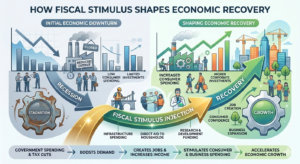
5. The Role of Fiscal Policy and the Multiplier Effect
The impact of taxation is also tied to the Fiscal Multiplier. This concept measures how much a change in government spending or taxing affects the total national output ($Y$).
The basic formula for the output in a closed economy is:
Where:
- $C$ = Consumption
- $I$ = Investment
- $G$ = Government Spending
When the government raises taxes ($T$), it reduces disposable income, which lowers $C$ and $I$. However, if that $T$ is used to increase $G$ (government spending) on high-return projects, the net effect on $Y$ can be positive. This is especially true during a recession, where the “multiplier effect” of government spending is often higher than the contractionary effect of the tax.
6. Modern Challenges: Globalization and Digitalization
The 21st century has introduced new hurdles for the tax-growth relationship:
- Digital Economy: How do you tax a company that has no physical presence in your country but generates millions in digital revenue?
- Tax Competition: “Race to the bottom” scenarios where countries lower corporate taxes to attract FDI (Foreign Direct Investment), potentially hollowing out their own public services.
- The Green Transition: Carbon taxes are becoming a vital tool. While they add a cost to production, they are intended to prevent the long-term economic catastrophe of climate change, proving that taxes can also be used for “negative externality” correction.
Conclusion: Finding the “Sweet Spot”
The relationship between taxes and economic growth is not a zero-sum game. Taxes are the price we pay for a civilized, functioning society that provides the platform for the private sector to thrive.
A growth-oriented tax system is one that:
- Minimizes distortions on investment and labor.
- Is broad-based (few loopholes) with moderate rates.
- Directs revenue toward high-return public investments like R&D and education.
- Maintains a stable and predictable environment for long-term planning.
Rather than asking “Should we lower taxes?”, policymakers should ask, “Is our tax system efficiently fueling the drivers of future growth?”
Would you like me to create a summary of this article in a different format, such as a slide presentation outline or an infographic brief?