Central banks are often viewed as the “conductors” of a nation’s economy. To maintain harmony—balancing low inflation with sustainable growth—they use a variety of instruments known as monetary policy tools. Among these, Open Market Operations (OMO) stands out as the most flexible, frequent, and powerful tool in a modern central bank’s arsenal.
Whether it is the Federal Reserve in the United States or the European Central Bank in the EU, OMO is the primary lever used to influence the amount of money circulating in the banking system and, by extension, the interest rates consumers and businesses pay.
What are Open Market Operations?
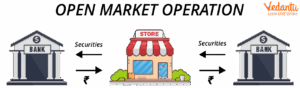
At its core, Open Market Operations refer to the buying and selling of government securities (such as Treasury bonds) by the central bank in the “open market.”
The term “open market” signifies that the central bank does not deal directly with the government to fund its debt. Instead, it interacts with primary dealers—large financial institutions like commercial banks and investment firms. By swapping securities for cash (or vice versa), the central bank directly alters the level of reserves that banks hold.
The Mechanics of OMO
When a central bank buys or sells bonds, it isn’t looking for a profit like a typical investor. Its goal is to change the monetary base.
- Buying Securities: When the central bank buys bonds, it pays the commercial banks with electronic cash. This increases the banks’ reserves. With more money on hand, banks are more willing to lend, which lowers interest rates.
- Selling Securities: When the central bank sells bonds, it takes cash out of the banking system in exchange for the securities. This reduces bank reserves, making credit tighter and pushing interest rates up.
The Dual Objectives: Expansionary vs. Contractionary Policy
Central banks don’t just move money for the sake of it; they act based on the current state of the business cycle.
1. Expansionary Monetary Policy
During a recession or a period of slow growth, the central bank aims to stimulate the economy.
- Action: The central bank buys government bonds.
- Result: Bank reserves increase $\rightarrow$ Supply of loanable funds rises $\rightarrow$ Interest rates fall.
- Impact: Lower rates encourage families to buy homes and businesses to invest in new equipment, boosting Aggregate Demand (AD).
2. Contractionary Monetary Policy
When the economy is “overheating”—characterized by high inflation and unsustainable growth—the central bank needs to cool things down.
- Action: The central bank sells government bonds.
- Result: Bank reserves decrease $\rightarrow$ Supply of loanable funds falls $\rightarrow$ Interest rates rise.
- Impact: Higher borrowing costs discourage spending and investment, helping to stabilize prices and curb inflation.
How OMO Influences Interest Rates
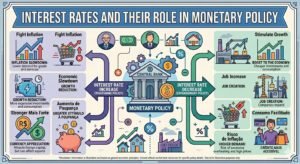
The most direct target of OMO is the Overnight Rate (in the U.S., this is the Federal Funds Rate). This is the interest rate banks charge each other to lend excess reserves overnight.
Because banks are required by law to maintain a certain level of reserves, those with a deficit must borrow from those with a surplus. By using OMO to adjust the total supply of these reserves, the central bank can “nudge” the market interest rate toward its desired target.
The relationship can be expressed through the demand and supply for bank reserves:
$$i = f(R_s, R_d)$$
Where:
- $i$ is the interest rate.
- $R_s$ is the supply of reserves (controlled by the central bank via OMO).
- $R_d$ is the demand for reserves by commercial banks.
The Advantages of Open Market Operations
Why do central banks prefer OMO over other tools like changing the Discount Rate or Reserve Requirements?
| Feature | Open Market Operations | Other Tools |
| Precision | Can be used to make tiny adjustments to reserves. | Often too “blunt” for daily fine-tuning. |
| Flexibility | Can be reversed quickly if the economic outlook changes. | Changing regulations is a slow, legal process. |
| Initiative | The central bank has complete control over the volume. | The Discount Rate depends on banks choosing to borrow. |
| Market-Based | Works through existing financial markets. | Can feel like a forced administrative mandate. |
Quantitative Easing: OMO on Steroids
In extreme cases, such as the 2008 Financial Crisis or the COVID-19 pandemic, standard OMO might not be enough—especially if interest rates are already near zero (the “Zero Lower Bound”).
In these scenarios, central banks engage in Quantitative Easing (QE). While QE is technically a form of Open Market Operations, it differs in scale and scope. Instead of just buying short-term Treasury bills, the central bank buys long-term bonds, corporate debt, and mortgage-backed securities to inject massive amounts of liquidity into the broader economy.
Potential Risks and Limitations
While OMO is highly effective, it is not a magic wand. There are several challenges central banks face:
- Time Lags: It can take 6 to 18 months for a change in monetary policy to fully impact GDP and inflation.
- Liquidity Traps: If businesses and consumers are too pessimistic, they may refuse to spend or invest even if the central bank pushes interest rates to zero.
- Inflationary Pressure: If the central bank buys too many securities (printing too much money), it risks devaluing the currency and causing hyperinflation.
Key Takeaway: Open Market Operations are the “steering wheel” of the economy. By buying and selling securities, the central bank ensures the engine doesn’t stall (recession) nor overheat (inflation).
Conclusion
Understanding Open Market Operations is essential for anyone looking to grasp how the global economy functions. By manipulating bank reserves through the purchase and sale of securities, central banks exert a profound influence on interest rates, investment, and the overall health of the financial system. As we move further into a digital age, the “market” in Open Market Operations may evolve, but the fundamental principle of managing liquidity will remain the cornerstone of economic stability.
Would you like me to create a summary table comparing OMO with the Reserve Requirement and the Discount Rate for better clarity?