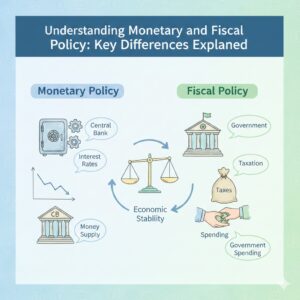
In the complex machinery of a modern economy, few levers are as powerful—or as scrutinized—as monetary policy. Managed by a country’s central bank (such as the Federal Reserve in the U.S., the ECB in Europe, or the Copom in Brazil), monetary policy is the primary tool used to steer the ship of state through the choppy waters of the global market.
At its core, monetary policy is about managing the supply of money and the cost of borrowing to achieve a specific set of goals: stable prices (low inflation) and sustainable economic growth. However, these two goals are often in tension. Understanding how central banks navigate this trade-off is essential for investors, policymakers, and everyday consumers alike.
1. The Toolkit of Monetary Policy
Before diving into the influence on growth and inflation, we must understand the “tools” central banks use. While the specifics vary by country, three main instruments dominate:
- Interest Rates: The most visible tool. By setting the “target rate” (the rate at which banks lend to each other), the central bank influences every other interest rate in the economy, from mortgages to credit cards.
- Open Market Operations (OMO): This involves the buying and selling of government bonds. When a central bank buys bonds, it injects cash into the banking system; when it sells, it sucks cash out.
- Reserve Requirements: By changing the amount of cash banks must hold in reserve (and not lend out), central banks can directly control how much credit is available in the economy.
2. Curbing the Fire: How Policy Influences Inflation
Inflation is the rate at which the general level of prices for goods and services rises. While a small amount of inflation is often seen as a sign of a healthy, growing economy, hyperinflation or even high single-digit inflation erodes purchasing power and creates economic instability.
Contractionary Monetary Policy
When inflation rises above the target (usually around 2%), central banks employ contractionary (or “tight”) monetary policy.
- Raising Interest Rates: When the cost of borrowing increases, consumers are less likely to take out loans for cars or homes, and businesses are less likely to fund expansions.
- Slowing Demand: As spending cools, the “aggregate demand” for goods decreases.
- Price Stabilization: With less money chasing the same amount of goods, the pressure on prices eases, and inflation begins to trend downward.
The Lag Effect: It is important to note that monetary policy does not work overnight. It often takes 12 to 18 months for an interest rate hike to fully filter through the economy and impact price levels.
3. Fueling the Engine: How Policy Drives Economic Growth
Economic growth, measured by Gross Domestic Product (GDP), represents the total value of all goods and services produced. When the economy stalls or enters a recession, central banks shift gears.
Expansionary Monetary Policy
To stimulate a sluggish economy, central banks use expansionary (or “easy”) monetary policy.
- Lowering Interest Rates: This makes borrowing “cheap.” It encourages households to spend and businesses to invest in new equipment, technology, and hiring.
- Increasing Money Supply: Through mechanisms like Quantitative Easing (QE)—where the bank buys long-term securities—the bank ensures that the financial system is flushed with liquidity.
- Boosting Confidence: Low rates signal to the market that the central bank is committed to growth, which can improve investor sentiment and consumer spending.
4. The “Phillips Curve” and the Trade-Off
The relationship between inflation and growth is often visualized through the Phillips Curve, which historically suggested an inverse relationship between unemployment (a proxy for growth) and inflation.
- High Growth/Low Unemployment: Usually leads to higher inflation as wages rise and demand peaks.
- Low Growth/High Unemployment: Usually leads to lower inflation (or even deflation) as demand craters.
Central bankers aim for the “Goldilocks Zone”—an economy that is neither too hot (causing inflation) nor too cold (causing recession).
5. Modern Challenges: Stagflation and Supply Shocks
The traditional playbook assumes that inflation is driven by “demand-pull” (consumers spending too much). However, the 2020s have highlighted the danger of “cost-push” inflation, driven by supply chain disruptions or energy crises.
When growth is low (stagnation) but inflation is high, the condition is known as Stagflation. This is a central banker’s nightmare. Raising rates to fight inflation could worsen the recession, while lowering rates to help growth could send inflation spiraling. In these scenarios, monetary policy must be incredibly precise and often works in tandem with fiscal policy (government spending).
6. The Impact on the Individual
Why does this matter to you? Monetary policy dictates the “macro” environment of your “micro” life:
- Savings: High-interest rates benefit savers, as bank deposits yield more.
- Debt: Low-interest rates are a boon for debtors, making it easier to pay off student loans or mortgages.
- Employment: Expansionary policy generally supports job creation, while contractionary policy can lead to hiring freezes or layoffs as the economy cools.
Conclusion
Monetary policy is a balancing act of immense proportions. By adjusting the flow of money, central banks have the power to temper the flames of inflation or jump-start a stalled engine of growth. While the tools are technical—involving $r$ (real interest rates) and $M$ (money supply)—the outcomes are deeply human, affecting everything from the price of groceries to the security of one’s job.
As global markets become increasingly interconnected, the transparency and communication of central banks (often called “Forward Guidance”) have become just as important as the interest rate moves themselves. In a world of uncertainty, a steady hand on the monetary wheel remains the best defense against economic chaos.