Government spending is one of the most powerful—and debated—tools in a nation’s economic arsenal. From building highways and funding schools to providing social safety nets and national defense, the way a government allocates its resources shapes the trajectory of the national economy.
Understanding the nuances of public expenditure is crucial for grasping how modern economies function, how they recover from crises, and how they sustain long-term growth.
1. Defining Government Spending
Government spending, or public expenditure, refers to the total amount of money a government uses to provide goods and services and to redistribute income. Economists generally categorize this spending into three main types:
- Current Expenditure: Spending on day-to-day operations, such as salaries for public sector workers (teachers, police, doctors) and the maintenance of existing infrastructure.
- Capital Expenditure: Investment in long-term assets that increase the economy’s productive capacity, such as building new hospitals, airports, or high-speed rail.
- Transfer Payments: Money given to individuals without any corresponding exchange of goods or services. This includes social security, unemployment benefits, and subsidies.
2. The Keynesian Perspective: Stimulating Demand
The modern understanding of government spending was revolutionized by John Maynard Keynes during the Great Depression. Keynes argued that during economic downturns, private demand (from consumers and businesses) often falls, leading to a recessionary gap.
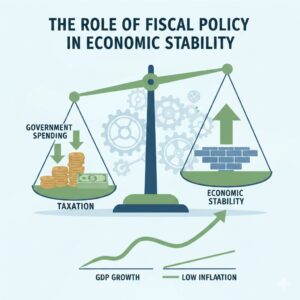
In such scenarios, the government can step in with Expansionary Fiscal Policy. By increasing spending, the government directly boosts “Aggregate Demand” (AD). This is often magnified by the Multiplier Effect.
The Spending Multiplier
The multiplier effect suggests that an initial injection of government spending leads to a larger overall increase in national income. For example, if the government spends $1 billion on a bridge, the construction workers and firms earn that money and subsequently spend it on groceries, cars, and services, creating further income for others.
The formula for the simple multiplier is
Where is the Marginal Propensity to Consume. If citizens spend a high percentage of their additional income, the multiplier effect is more potent.
3. Supply-Side Effects and Long-Term Growth
While Keynesians focus on the “demand” side, other economists emphasize how spending affects the “supply” side of the economy.
- Human Capital: Spending on education and healthcare creates a more skilled and healthy workforce, which increases productivity over decades.
- Infrastructure: Efficient transport and communication networks lower the costs for private businesses, making the entire economy more competitive.
- R&D: Government-funded research often leads to technological breakthroughs (like the internet or GPS) that private firms eventually commercialize.
4. The Potential Downsides: Crowding Out and Debt
Government spending is not a “free lunch.” Excessive spending, especially when financed by borrowing, can lead to several negative outcomes.
The Crowding Out Effect
When a government borrows heavily to fund its spending, it increases the demand for loanable funds. This can drive up interest rates. High interest rates make it more expensive for private businesses to borrow money for their own investments. Essentially, public spending “crowds out” private investment, potentially slowing down long-term innovation.
Inflationary Pressures
If the government spends heavily when the economy is already near full capacity (low unemployment), it can lead to “demand-pull inflation.” Too much money chasing too few goods causes prices to rise, eroding purchasing power.
Public Debt and Sustainability
Persistent deficit spending leads to an accumulation of national debt. While debt isn’t inherently bad, a high Debt-to-GDP ratio can lead to:
- High Interest Costs: A large portion of the budget goes toward paying interest rather than public services.
- Loss of Investor Confidence: If markets fear a government cannot repay its debt, they may demand even higher interest rates or cause a currency crisis.
5. Determinants of Effectiveness: The “Where” and “When”
The impact of government spending is highly dependent on two factors: efficiency and timing.
| Factor | Description |
| Corruption/Leaking | Spending in countries with high corruption often fails to reach its intended target, reducing the multiplier. |
| Economic Cycle | Spending is most effective during a recession (when resources are idle) and can be harmful during a boom (leading to overheating). |
| Type of Spending | Capital investments (infrastructure) generally have a higher long-term ROI than certain types of current expenditure. |
6. Modern Challenges: The Role of Automatic Stabilizers
Not all government spending is the result of new laws. Automatic Stabilizers are features of the budget that act to dampen economic fluctuations without explicit government intervention.
- In a Recession: More people claim unemployment benefits (spending increases), and tax revenue falls. This naturally provides a stimulus.
- In a Boom: Tax revenue increases and benefit payments fall, naturally cooling the economy.
Conclusion
Government spending is a double-edged sword. When used strategically, it can pull an economy out of a tailspin, bridge the gap in inequality, and lay the groundwork for future prosperity through infrastructure and education. However, when used recklessly, it risks triggering inflation, stifling private investment, and burdening future generations with unsustainable debt.
The goal for policymakers is not simply to spend “more” or “less,” but to spend better—prioritizing investments that yield high social and economic returns while maintaining fiscal responsibility.