When the economy shifts—whether it’s the sting of rising prices at the grocery store or the anxiety of a cooling job market—the invisible hand of government policy is usually at work behind the scenes. Central banks and federal governments primarily use two distinct toolsets to manage these fluctuations: Expansionary and Contractionary policies.
Understanding the difference between these two isn’t just for economists; it’s essential for investors, business owners, and anyone trying to navigate the financial landscape.
The Core Objective: Stability
At its heart, macroeconomic policy seeks to balance the “Goldilocks” state of an economy: not too hot (high inflation), not too cold (recession/high unemployment), but just right. This is achieved through two main channels:
- Monetary Policy: Controlled by central banks (like the Federal Reserve).
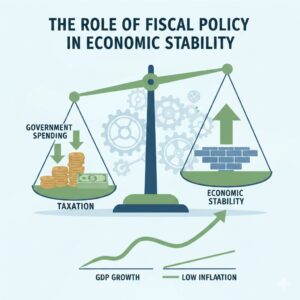
- Fiscal Policy: Controlled by the government (taxing and spending).
1. Expansionary Policy: Stepping on the Gas
Expansionary policy is used when an economy is slowing down or in a recession. The goal is to stimulate economic activity, increase consumer spending, and lower unemployment.
How It Works (Fiscal)
Governments “pump” money into the economy by:
- Increasing Public Spending: Funding infrastructure projects, education, or healthcare. This creates jobs and puts money directly into the hands of workers.
- Cutting Taxes: When individuals and businesses pay less in taxes, they have more disposable income to spend and invest.
How It Works (Monetary)
Central banks lower the barrier to borrowing money:
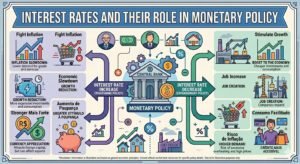
- Lowering Interest Rates: This makes loans (mortgages, car loans, business credit) cheaper, encouraging people to spend rather than save.
- Quantitative Easing (QE): The central bank buys government bonds to increase the money supply in the banking system.
The Goal: To increase the Aggregate Demand (AD). In economic terms, this is often represented by the formula:
$$AD = C + I + G + (X – M)$$
Where $C$ is consumption, $I$ is investment, $G$ is government spending, and $(X – M)$ is net exports.
The Trade-off
While expansionary policy can end a recession, if left unchecked for too long, it can lead to inflation. When too much money chases too few goods, prices inevitably rise.
2. Contractionary Policy: Hitting the Brakes
Contractionary policy is the “sobering” counterpart. It is deployed when the economy is growing too fast, leading to runaway inflation that devalues the currency and erodes purchasing power.
How It Works (Fiscal)
The government pulls money out of the economy by:
- Reducing Public Spending: Cutting back on projects to reduce the total amount of money circulating.
- Increasing Taxes: Higher taxes reduce the amount of money consumers have to spend, cooling down demand.
How It Works (Monetary)
The central bank makes it more expensive to borrow:
- Raising Interest Rates: Higher rates discourage borrowing and encourage saving. If a business loan costs 10% instead of 3%, a company is less likely to expand.
- Open Market Operations: Selling government bonds to “mop up” excess cash from the system.
The Trade-off
The risk of contractionary policy is that it might work “too well.” If the brakes are hit too hard, the economy can slip into a recession, and unemployment may rise as businesses scale back.
Key Differences at a Glance
| Feature | Expansionary Policy | Contractionary Policy |
| Main Goal | Fight recession & unemployment | Fight high inflation |
| Interest Rates | Decreased | Increased |
| Gov. Spending | Increased | Decreased |
| Taxation | Decreased | Increased |
| Money Supply | Expanded | Restricted |
| Economic Effect | Stimulates growth | Slows down growth |
The Role of the Business Cycle
The choice between these policies depends entirely on where a country sits in the Business Cycle.
- Trough/Recession: Expansionary policy is the go-to tool to jumpstart growth.
- Expansion/Peak: As the economy nears its peak and inflation starts to creep up, contractionary policy is introduced to ensure a “soft landing.”
Real-World Application: The Post-2020 Era
A perfect modern example of these policies in action occurred during and after the COVID-19 pandemic.
- 2020-2021 (Expansionary): Governments worldwide issued stimulus checks and kept interest rates near zero to prevent a total economic collapse during lockdowns.
- 2022-2024 (Contractionary): As a result of supply chain issues and the massive influx of stimulus, inflation hit 40-year highs. Central banks, led by the Fed, rapidly raised interest rates to “cool” the economy down.
Why This Matters for You
Knowing which policy is currently in play helps you make better financial decisions:
- During Expansionary Phases: It is usually a better time to take out a mortgage or borrow for a business, as rates are low. Stock markets often perform well due to increased liquidity.
- During Contractionary Phases: It’s a good time to look for high-yield savings accounts or bonds, as interest rates on savings rise. However, it’s often a riskier time for high-growth stocks that rely on cheap debt.
Final Thoughts
Neither policy is “better” than the other; they are simply tools in a kit. The challenge for policymakers is timing. Implementing expansionary policy too late can lead to a depression; implementing contractionary policy too early can kill a recovery.
By understanding these mechanisms, you can peer through the noise of financial news and understand the “why” behind the numbers.
Would you like me to create a more specific breakdown of how these policies currently affect the stock market or the housing market?