In the complex machinery of global finance, few institutions wield as much power or command as much scrutiny as central banks. Often described as the “lenders of last resort” or the “guardians of the currency,” these entities are the primary architects of a nation’s economic environment. From the Federal Reserve in the United States to the European Central Bank (ECB) and the Bank of Japan, central banks influence everything from the interest you pay on a mortgage to the price of a gallon of milk.
As we navigate the economic landscape of 2026, understanding how these institutions operate is not just for economists—it is essential for any informed citizen or investor.
The Core Mandate: Stability and Growth
At their heart, central banks are established to provide stability. While their specific legal mandates vary by country, most revolve around two primary goals, often referred to as the Dual Mandate:
- Price Stability (Inflation Control): Ensuring that money maintains its purchasing power over time. Most modern central banks aim for a target inflation rate, typically around 2%.
- Full Employment: Promoting economic conditions that support the highest sustainable level of employment.
Beyond these, central banks are responsible for overseeing the commercial banking system, managing national foreign exchange reserves, and ensuring the smooth operation of the payments system.
The Toolkit: How Central Banks Move the Needle
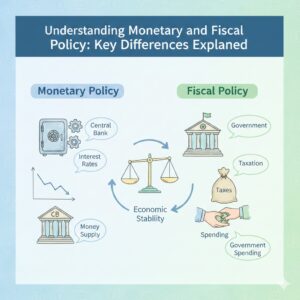
Central banks do not control the economy directly; instead, they influence it through monetary policy. They have several sophisticated tools at their disposal to expand or contract the “money supply”—the total amount of money circulating in the economy.
1. Interest Rates (The Policy Rate)
This is the most visible tool. By setting the “base rate” (like the Federal Funds Rate in the U.S.), the central bank influences the cost of borrowing throughout the entire economy.
- Lowering Rates: Stimulates the economy by making loans cheaper for businesses to expand and consumers to buy homes or cars.
- Raising Rates: Cools down an “overheated” economy and combats inflation by making borrowing more expensive, which slows spending.
2. Open Market Operations (OMO)
Central banks buy and sell government securities (bonds) in the open market. When a central bank buys bonds, it injects cash into the banking system, increasing the money supply. Conversely, selling bonds pulls cash out of the system.
3. Reserve Requirements
Commercial banks are required to hold a certain percentage of their deposits in reserve (either in their vaults or at the central bank). By adjusting this ratio, the central bank can control how much money commercial banks are able to lend out.
4. Quantitative Easing (QE) and Tightening (QT)
In times of extreme crisis, central banks may engage in Quantitative Easing—large-scale asset purchases intended to lower long-term interest rates and provide massive liquidity. In 2026, many nations are still managing the “normalization” process (Quantitative Tightening) as they attempt to shrink the massive balance sheets accumulated during previous decades.
The Transmission Mechanism: From Policy to Your Pocket
The impact of central bank decisions is felt through what economists call the Transmission Mechanism. This process describes how a change in the central bank’s policy rate ripples through the financial system.
- The Cost of Credit: When the central bank raises rates, banks raise the interest they charge on credit cards, personal loans, and business lines of credit.
- Asset Prices: Higher interest rates often make bonds more attractive relative to stocks, which can lead to shifts in the stock market.
- Exchange Rates: If a country raises interest rates, its currency often strengthens as international investors seek higher returns. This makes imports cheaper but can make exports less competitive.
- Expectations: Perhaps the most powerful tool is “Forward Guidance.” By simply stating what they intend to do in the future, central banks can influence market behavior today.
Modern Challenges: Central Banking in 2026
The role of central banks has evolved significantly over the last few years. Today, they face a unique set of challenges that weren’t on the radar a decade ago.
The Battle Against “Sticky” Inflation
Following the global shocks of the early 2020s, many economies experienced persistent inflation. In 2026, central banks remain hyper-focused on ensuring that inflation expectations don’t become “unanchored.” This requires a delicate balancing act: keeping rates high enough to suppress prices without triggering a deep recession.
Digital Currencies and CBDCs
One of the most transformative shifts is the rise of Central Bank Digital Currencies (CBDCs). Unlike decentralized cryptocurrencies, CBDCs are digital forms of a nation’s fiat currency, issued and regulated by the central bank. These aim to improve payment efficiency and financial inclusion while maintaining the bank’s control over monetary policy.
Climate Change and Green Finance
Increasingly, central banks are considering “climate risk” as a factor in financial stability. They are now evaluating how extreme weather events and the transition to a low-carbon economy could impact the solvency of the banks they supervise.
Why Independence Matters
A critical theme in central banking is independence. History has shown that when politicians control the printing press, they are often tempted to print money to fund short-term spending, leading to hyperinflation (as seen historically in Weimar Germany or more recently in Zimbabwe and Venezuela).
To prevent this, most modern central banks are designed to be independent of the government’s executive branch. This allows them to make “tough” decisions—like raising interest rates right before an election—that are necessary for long-term economic health but unpopular in the short term.
Conclusion
Central banks are the “invisible hand” that guides the modern economy. By managing the cost and availability of money, they strive to create an environment where businesses can thrive, and citizens can trust the value of their savings. While their tools have become more complex—ranging from interest rate hikes to the management of digital currencies—their fundamental goal remains the same: Stability.
As global markets become more interconnected, the decisions made in the boardrooms of the Federal Reserve or the ECB will continue to resonate in every corner of the world, shaping the prosperity of generations to come.