The financial health of a nation is often measured by its ability to balance its books. However, in the modern era, “balancing the books” has become the exception rather than the rule. Terms like budget deficit and national debt dominate political discourse and financial news, yet the mechanics behind these numbers—and their real-world impact—are often misunderstood.
To understand the global economy, one must distinguish between the deficit and the debt. While they are inextricably linked, they represent different financial realities. A budget deficit occurs when a government’s expenditures exceed its revenue within a single fiscal year. The national debt, conversely, is the accumulation of these yearly deficits over time, minus any surpluses.
The Anatomy of a Budget Deficit
A deficit is not necessarily a sign of a failing economy; it is a reflection of fiscal policy choices. There are two primary drivers that tilt the scales toward a deficit:
1. Revenue Shortfalls
The primary source of income for any government is taxation. When tax revenues fall, a deficit is likely to emerge. This can happen due to:
- Economic Recessions: During a downturn, corporate profits shrink and unemployment rises, leading to lower income and sales tax collections.
- Tax Policy: Legislative decisions to cut corporate or individual tax rates, intended to stimulate investment, often lead to an immediate drop in federal revenue.
2. Expenditure Surges
Governments spend money on “automatic stabilizers” and discretionary projects. Common causes for increased spending include:
- Social Safety Nets: Programs like Social Security, Medicare, and unemployment insurance require consistent funding, which often increases as populations age.
- Defense and Infrastructure: National security and the maintenance of public goods (roads, bridges, power grids) represent massive, non-negotiable costs.
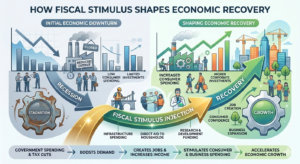
- Crisis Response: Unforeseen events, such as global pandemics or financial collapses, necessitate massive “stimulus” spending to prevent total economic breakdown.
The Path from Deficit to National Debt
When a government runs a deficit, it must borrow money to cover the gap. This is typically done by issuing Government Securities, such as Treasury Bonds, Notes, and Bills. These instruments are purchased by individual investors, corporations, and even foreign governments.
The National Debt is the total amount of outstanding money owed by the federal government to these creditors. It is a “stock” variable, whereas the deficit is a “flow” variable. As long as a country continues to run deficits, the national debt will continue to climb.
The Consequences: Why Debt Matters
The impact of high national debt is a subject of intense debate among economists. Some argue that debt is a vital tool for growth, while others warn of a looming “debt trap.”
1. The Burden of Interest Payments
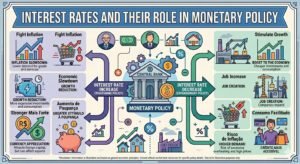
Just like a personal loan, national debt carries interest. As the total debt grows, a larger portion of the annual budget must be dedicated to paying interest rather than investing in education, technology, or healthcare. If interest rates rise, the cost of servicing this debt can spiral, creating a “crowding out” effect where private investment is stifled because the government is consuming all available credit.
2. Inflationary Pressures
In extreme cases, if a government cannot meet its debt obligations through taxation or borrowing, it may resort to “printing money.” Increasing the money supply too rapidly without a corresponding increase in economic output leads to hyperinflation, devaluing the currency and eroding the purchasing power of citizens.
3. Reduced Fiscal Flexibility
A country with a high debt-to-GDP ratio has less “dry powder” to deal with the next crisis. If a nation is already heavily leveraged, it may find it difficult or prohibitively expensive to borrow the funds needed to respond to a future war, natural disaster, or economic depression.
4. Intergenerational Equity
Perhaps the most significant ethical concern is the transfer of debt to future generations. Today’s spending, funded by debt, must eventually be paid for by tomorrow’s taxpayers through higher taxes or reduced public services.
The Role of the Debt-to-GDP Ratio
Economists often look at the Debt-to-GDP Ratio rather than the raw dollar amount of debt. This ratio compares what a country owes to what it produces.
A country with a high debt (like the USA or Japan) can sustain that debt as long as its economy (GDP) is large enough and growing fast enough to manage the payments. A rising ratio suggests that the debt is growing faster than the economy, which is generally considered unsustainable in the long run.
Strategies for Fiscal Sustainability
Managing a national budget is a delicate balancing act. There are three primary “levers” a government can pull to address growing debt:
- Austerity: This involves significant cuts to government spending. While effective at reducing the deficit, it can also slow economic growth and lead to social unrest.
- Tax Reform: Increasing revenue through higher taxes or by closing loopholes. This is often politically difficult but can provide a stable path toward a balanced budget.
- Economic Growth: This is the “gold standard.” If a country’s economy grows faster than its debt, the debt-to-GDP ratio will naturally fall. This is why governments often prioritize investments in innovation and infrastructure.
Conclusion
Budget deficits and national debt are not inherently “evil.” They are financial tools that, when used wisely, can smooth out economic cycles and fund essential public services. However, when debt grows unchecked, it creates structural risks that can undermine the long-term prosperity of a nation.
For investors and citizens alike, understanding these concepts is crucial. In an increasingly interconnected global economy, the fiscal stability of one nation—particularly a major economy—can have ripple effects that touch every corner of the financial world.
Would you like me to translate this article into German or Portuguese, or perhaps create a follow-up piece focusing specifically on the impact of U.S. ETFs on global debt markets?