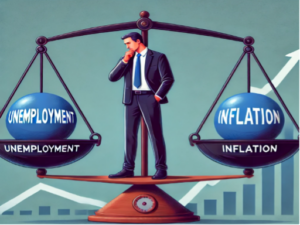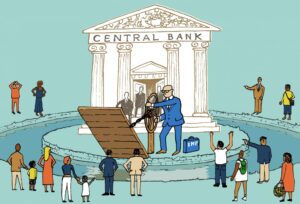
For decades, the relationship between inflation and unemployment has served as the “Holy Grail” of macroeconomic policy. Central banks and governments worldwide operate in a constant state of calibration, attempting to foster an environment where prices remain stable and the workforce remains engaged. However, these two goals often sit on opposite ends of a see-saw: push one down, and the other inevitably rises. This tension, known as the policy trade-off, forms the bedrock of modern economic theory and practical governance.
The Theoretical Foundation: The Phillips Curve
The most famous representation of this trade-off is the Phillips Curve. Introduced by economist A.W. Phillips in 1958, the original concept suggested an inverse relationship between money wage changes and unemployment. In simpler terms, when unemployment is low, labor is scarce, and workers can demand higher wages. These higher wages translate into increased production costs and higher consumer spending, both of which drive up inflation.
Conversely, when unemployment is high, the “slack” in the labor market keeps wages suppressed, leading to lower inflationary pressure.
Short-Run vs. Long-Run
Modern economics distinguishes between the short-run and long-run Phillips Curve. In the short run, a government might successfully “buy” lower unemployment by accepting a higher rate of inflation through monetary expansion. However, the Natural Rate of Unemployment theory—often associated with Milton Friedman and the “Monetarists”—suggests that in the long run, this trade-off vanishes.
Expectations play a crucial role here. If workers expect 5% inflation, they will demand 5% raises just to stay level. If the government tries to push unemployment below its “natural” state, inflation simply spirals upward without creating lasting jobs. This lead to the concept of the NAIRU (Non-Accelerating Inflation Rate of Unemployment).
The Mechanisms of Policy Intervention
Governments and central banks use two primary levers to manage this balance: Monetary Policy and Fiscal Policy.
1. Monetary Policy
Central banks, such as the Federal Reserve or the European Central Bank, primarily use interest rates and money supply control.
- Expansionary Policy: During a recession, central banks lower interest rates. This makes borrowing cheaper for businesses to expand and consumers to buy homes or cars. While this lowers unemployment, it risks “overheating” the economy, leading to high inflation.
- Contractionary Policy: If inflation is surging, central banks raise interest rates. This “cools” the economy by making credit expensive, which reduces spending but often leads to job losses as businesses scale back.
2. Fiscal Policy
This involves government spending and taxation.
- Stimulus: Direct spending on infrastructure or social programs can create jobs immediately.
- Austerity: Reducing deficits can help control inflation by lowering the total demand in the economy, though it is often politically unpopular due to its impact on employment and public services.
The Challenge of Stagflation
The neat trade-off of the Phillips Curve was shattered in the 1970s by a phenomenon called Stagflation. This occurs when an economy experiences stagnant growth (high unemployment) and high inflation simultaneously.
Usually caused by “supply shocks”—such as the 1973 oil crisis—stagflation presents a nightmare scenario for policymakers. If they lower interest rates to help the unemployed, they make inflation worse. If they raise rates to stop inflation, they deepen the recession. This era taught economists that the “trade-off” is not always a choice between two evils; sometimes, you get both.
Modern Dynamics: Why the Curve Flattened
In the last decade, particularly between 2010 and 2020, the traditional link between inflation and unemployment seemed to weaken—a phenomenon economists call the “flattening” of the Phillips Curve. Several factors contributed to this:
- Globalization: Even when the local labor market is tight, companies can outsource production or rely on global supply chains, preventing local wage increases from driving up prices.
- Technology and Automation: Productivity gains through AI and automation allow companies to grow without necessarily hiring more people or raising prices.
- Central Bank Credibility: Because modern central banks are so committed to “Inflation Targeting” (usually around 2%), public expectations of inflation have become “anchored.” People no longer panic and demand massive raises the moment unemployment drops.
The Social Cost of the Trade-Off
Choosing between inflation and unemployment is not just a mathematical exercise; it is a moral one.
- The Cost of Inflation: High inflation erodes savings, hurts those on fixed incomes (like retirees), and creates uncertainty that discourages long-term investment. Hyperinflation can lead to total social collapse.
- The Cost of Unemployment: High unemployment leads to lost human capital, increased mental health issues, higher crime rates, and social instability. Long-term unemployment can “scar” a generation, reducing their earning potential for life.
Policymakers must decide which “pain” the population is better equipped to handle at any given moment.
Strategy for a Balanced Future
To achieve a “Soft Landing”—where inflation is brought down without triggering a massive recession—policymakers are increasingly looking beyond simple interest rate hikes.
- Supply-Side Policies: Instead of just managing demand, governments can focus on increasing the economy’s capacity. This includes investing in education (to make workers more employable) and reducing “red tape” for businesses.
- Targeted Fiscal Support: Rather than broad-based stimulus, using surgical strikes of capital into sectors like renewable energy or tech can create jobs in high-growth areas that don’t immediately spike consumer price indices.
Conclusion
The trade-off between inflation and unemployment remains the central challenge of economic management. While the “sweet spot” of low inflation and full employment is rarely maintained for long, understanding the nuances of the Phillips Curve, the impact of global supply chains, and the power of inflation expectations allows for more resilient policy-making.
In an era of rapid technological change and geopolitical shifts, the tightrope may be higher and the wind stronger, but the goal remains the same: an economy that provides opportunity for the many while protecting the purchasing power of all.
This article provides an overview of macroeconomic principles for educational purposes. For specific investment or policy advice, consult with a qualified financial professional.