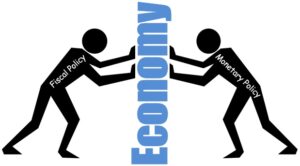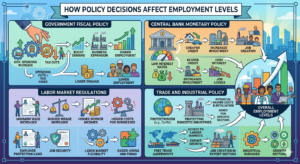
Economic recessions are inevitable phases of the business cycle characterized by a significant decline in economic activity across the economy, lasting more than a few months. While the causes of recessions vary—ranging from financial bubbles and geopolitical shocks to pandemics—the policy responses generally fall into two primary categories: Monetary Policy and Fiscal Policy.
In the modern era, especially following the global upheavals of 2008 and 2020, these traditional tools have been augmented by “unconventional” measures. This article explores how governments and central banks stabilize economies, the trade-offs involved, and the emerging focus on “green” recovery.
1. Monetary Policy: The First Line of Defense
Monetary policy is managed by a country’s central bank (such as the Federal Reserve in the U.S. or the European Central Bank). It is often the first tool deployed because central banks can act much faster than legislatures.
Traditional Tools
- Interest Rate Cuts: By lowering the “policy rate,” central banks make borrowing cheaper for businesses and consumers. This encourages spending on big-ticket items like houses and cars, and incentivizes businesses to invest in expansion.
- Open Market Operations: Central banks buy government bonds to inject liquidity into the banking system, ensuring that banks have enough cash to continue lending.
Unconventional Monetary Policy
When interest rates hit the Zero Lower Bound (ZLB)—meaning they cannot be lowered further—central banks turn to more aggressive tactics:
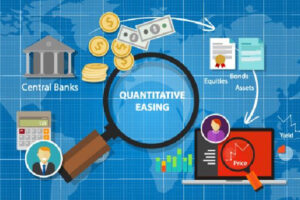
- Quantitative Easing (QE): The central bank creates new electronic money to buy long-term securities, such as government bonds and corporate debt. This lowers long-term interest rates and keeps credit flowing.
- Forward Guidance: This is a communication strategy where the central bank pledges to keep interest rates low for an extended period or until certain economic benchmarks (like a specific unemployment rate) are met. It aims to influence the long-term expectations of investors and consumers.
2. Fiscal Policy: The Power of the Purse
While monetary policy influences the cost of money, fiscal policy involves direct government intervention through taxing and spending. This requires legislative approval, which often makes it slower to implement but potentially more powerful in its direct impact.
Expansionary Fiscal Tools
- Government Spending: Increasing expenditure on infrastructure, healthcare, or education creates immediate demand for goods and services and generates jobs.
- Tax Cuts: Reducing personal or corporate taxes leaves more “disposable income” in the hands of the public, theoretically boosting private consumption and investment.
- Transfer Payments: During crises, governments often expand “social safety nets,” such as unemployment insurance or direct stimulus checks (as seen during the COVID-19 pandemic). These are highly effective because they target individuals with a high marginal propensity to consume.
The Fiscal Multiplier Effect
The effectiveness of fiscal policy is often measured by the multiplier. If a government spends $1 and it results in an increase of $1.50 in GDP, the multiplier is 1.5. This happens because the initial spending becomes income for workers, who then spend it elsewhere, creating a chain reaction of economic activity.
3. The Challenges of Policy Coordination
The most effective recoveries occur when monetary and fiscal policies work in tandem. However, this coordination is fraught with challenges:
| Challenge | Description |
| Lag Time | Fiscal policy often suffers from “recognition lags” (realizing there is a recession) and “implementation lags” (passing and spending the budget). |
| Crowding Out | Excessive government borrowing can drive up interest rates, potentially “crowding out” private investment. |
| Inflationary Risk | If stimulus is too aggressive or poorly timed, it can lead to overheating and high inflation, requiring a painful reversal of policy later. |
| Public Debt | Prolonged fiscal stimulus increases the debt-to-GDP ratio, which can limit a country’s ability to respond to future crises. |
4. Modern Trends: The “Green” and “Industrial” Pivot
In the 2020s, a new paradigm has emerged: Green Stimulus. Instead of just “filling the hole” left by a recession, policymakers are using recovery funds to accelerate the energy transition.
- Targeted Investment: Governments are directing stimulus toward renewable energy, electric vehicle infrastructure, and building retrofits.
- Modern Industrial Policy: There is a renewed focus on securing supply chains and fostering domestic “green” industries. By subsidizing high-tech manufacturing during a downturn, countries hope to emerge from the recession with a more competitive, sustainable economy.
Key Insight: Unlike traditional “shovel-ready” projects, green stimulus aims to solve two problems at once: short-term unemployment and long-term climate risk.
5. Conclusion: A Balancing Act
There is no “one-size-fits-all” response to an economic recession. A mild recession may only require subtle interest rate adjustments, while a systemic financial crisis might necessitate trillion-dollar stimulus packages and unconventional central bank interventions.
As we move toward 2026, the focus has shifted from simple stabilization to resilience. Policymakers are increasingly aware that the quality of the recovery—how inclusive and sustainable it is—matters just as much as the speed of the recovery.
Would you like me to create a more specific analysis of how these policies were applied during a particular historical recession, such as the 2008 Financial Crisis or the 2020 Pandemic?